Tracked drive, RTK/VSLAM navigation, 100% claimed slope handling, and 1.73 acres/day coverage make it a unique all-terrain entrant.
Last verified 2026-09-13
Elite90/100
Affiliate disclosure: MowScout earns a commission when you buy through our links, including as an Amazon Associate. Recommendations are based on yard fit, verified specs, and score methodology; commission can only break close ties among genuine fits.
MowScout verdict
Buy if your yard matches its strengths.
Buy if
Tracked drive, RTK/VSLAM navigation, 100% claimed slope handling, and 1.73 acres/day coverage make it a unique all-terrain entrant.
Skip if
The slope, area, and noise claims need measured-context caveats; it is loud and still a young platform.
Pros
Tracked drive, RTK/VSLAM navigation, 100% claimed slope handling, and 1.73 acres/day coverage make it a unique all-terrain entrant.
Cons
The slope, area, and noise claims need measured-context caveats; it is loud and still a young platform.
Fit check
What to verify before buying
Lymow One Plus is a $3,199 mower rated for 1.73 acres, 100% slopes, and 80 mapped zones. MowScout does not yet have a separate source-verified daily coverage figure for this model. Treat those as fit limits, not marketing decoration: mowable grass, wet turns, separate zones, and spring growth should all leave enough headroom for the mower to run without repeated rescues.
Navigation is hybrid and drive is TRACKS. This model needs careful antenna or base-station placement, so buyers should plan for open sky, clean power, and a dock location that does not force the mower through a weak-signal corridor every day. AI vision obstacle avoidance is useful around toys, furniture, pets, and landscaping clutter, but it should be treated as a risk reducer rather than a safety guarantee.If your hardest constraint is slope or rough turf, compare the terrain guide; if setup simplicity is the priority, compare similar no-wire picks before choosing by price.
Before checkout, confirm the exact SKU, included dock or base hardware, return window, warranty path, and current price at one of the listed retailers: Lymow. Robot mower bundles change quickly, so the retailer page should match this review's capacity, model name, and last-verified source trail.
In the current catalog, this model sits in the estate price tier with 4 other verified mowers nearby. Its rough price-per-rated-acre is $1,849, which is useful when comparing against a larger mower that may look expensive upfront but cheaper per acre. Segway Navimow X450 is the closest lower-priced comparison point at $2,999.
The capacity math is pending source verification beyond its 1.73 acres max-area rating. That matters when the lawn is close to the published limit, because a mower that can only cover the whole yard under ideal conditions has less margin after rain delays, fast spring growth, dull blades, or separated zones. If your measured turf is close to 1.73 acres, compare Yarbo Lawn Mower Pro for more headroom before buying.
The tags attached to this record are steep slopes, estate yards, tracked drive, rough terrain. Use those as a sanity check: if your yard does not match at least two of those tags, the MowScout Score is less important than fit. A high-scoring mower in the wrong category still creates rescue trips, missed strips, and support friction.
Its current MowScout Score is 90, which should be read beside the hard specs rather than treated as a standalone verdict. The strongest reasons to keep this mower on a shortlist are its hybridnavigation, TRACKS drive, 100% slope rating, and 80zone support. The biggest reason to remove it is any yard fact that directly conflicts with those numbers.
Cutting fit is also specific: this deck is 16 inches wide and adjusts from 1.2 to 4 inches. Edge behavior is rated "ok", so expect some trim work around fences, walls, beds, curbs, and tight hardscape. That is normal for robot mowers, but it matters more if your lawn has a lot of border length relative to open grass.
Ownership details point to 3 years of warranty coverage, app quality rated 3out of 5, connectivity through wifi, bt, 4g, 68 dB of listed noise, and 78.5 lb of chassis weight. Those are practical details for storage, night schedules, support expectations, and whether the mower will be easy to lift, clean, or move between areas.
The source trail for this record was last checked on 2026-09-13 and includes Lymow One Plus official product page, Lymow price guide, Lymow support: rain sensor sends the mower to its dock. Use those sources to resolve any mismatch between this review, a retailer title, and a bundled accessory listing. If the source page changes the area rating, slope rating, included hardware, or warranty terms, update the shortlist before clicking through. Keep a screenshot of the retailer specs for returns.
These checks are not MowScout lab results. They are manufacturer-claim caveats or third-party measured data we track so readers can separate dry-condition ratings from real-yard expectations.
Noise
third party
Rated / claimed
68 dB claimed
Observed / caveat
73-78 dB in early third-party reports
The tracked mulching platform appears meaningfully louder than quiet residential robot mowers; avoid assuming late-night whisper-quiet operation.
The current price path is a direct retailer or manufacturer link, not an approved commission-bearing affiliate program. We still label the outbound button conservatively because it leaves MowScout for a buying page, but this model is not being boosted by a hidden payout. Once a formal affiliate program is approved, commission terms can be added without changing the score.
The source trail was last checked on 2026-09-13. Current source labels are Lymow One Plus official product page, Lymow price guide, Lymow support: rain sensor sends the mower to its dock. If a retailer changes the bundle, slope claim, included antenna or base hardware, warranty, subscription period, or street price, treat the retailer page as the checkout source of truth and use the review as a fit screen.
Score breakdown
navigation25
terrain20
coverage12
setup11
cutting9
value9
support4
The Lymow One Plus is the most unusual robot mower in our 2026 database: a tracked, large-capacity machine from a newer brand that markets a 100% (45-degree) slope rating and a wide 16-inch deck at a price below the other tracked platform we track. After the July data correction, MowScout records it at 1.73 acres of max area and 1.73 acres/day of daily coverage, not the earlier 12-acre marketing read, and its recomputed spec score is 90/100. That number is real arithmetic on our current catalog inputs, but it still needs caution because the slope claim and the young platform are not independently proven. This is a data-driven review, not a hands-on one: MowScout scores are computed from verified manufacturer and retailer specifications and cross-checked against professional and owner reports, which we attribute below. We have not run this unit ourselves, and we won't pretend to have.
### MowScout Score: 90/100 — high capability, with young-platform caveats The verdict, in three lines: On current catalog inputs, the Lymow One Plus is a genuinely compelling tracked estate mower: real all-terrain hardware, 1.73-acre max/daily coverage, a wide 16-inch deck, and a price well below the other tracked machine in our lineup. But the 90/100 is still a spec-derived ceiling, not proven field performance: its terrain score leans on a 100% slope claim we have not measured, and the brand is still young and direct-only. Treat it as a high-upside, verify-before-you-buy machine rather than a safe default. Street price: \$3,199 at Lymow's US store (regular price), verified September 13, 2026 — verify current price. FTC disclosure: the link below is an affiliate link; if you buy through it, MowScout may earn a commission at no extra cost to you. See our full disclosure. Our score and our cautions are computed and written independently of any commission.→ Check today's Lymow One Plus deal
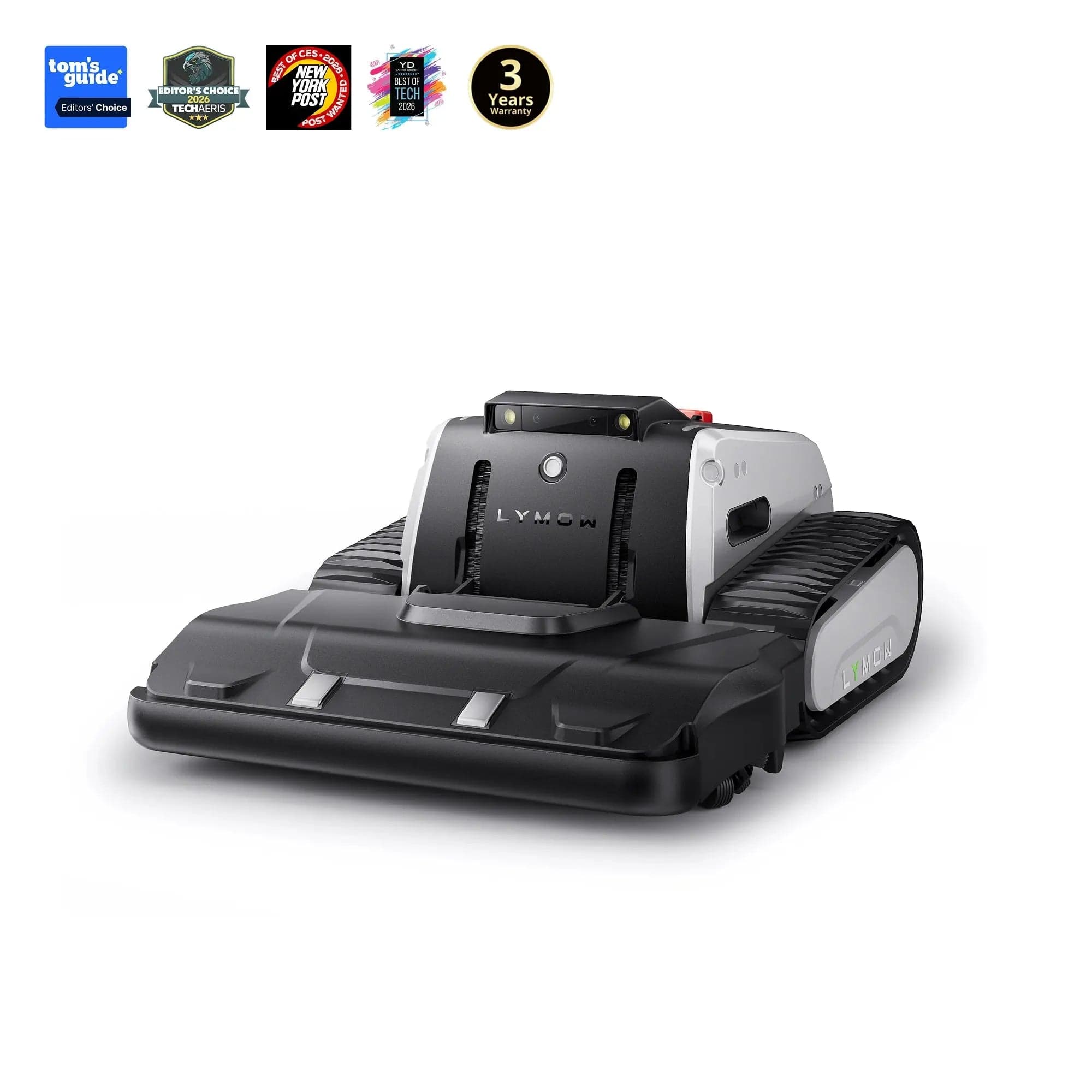
Lymow One Plus tracked robot lawn mower
Image: MowScout never AI-generates product images.
Reasons to buy / reasons to skip
Reasons to buy
✅ Genuinely differentiated hardware. Rubber tracks (not wheels) spread ~78.5 lb over a large contact patch for real traction on slopes, roots, and soft ground — the standout reason to consider it.
✅ Large verified catalog capacity for the money. A 1.73-acre max/daily coverage rating undercuts the other tracked estate mower in our lineup, the Yarbo, by a wide margin on price.
✅ Capable navigation stack on paper. Hybrid RTK/VSLAM positioning plus AI-vision obstacle avoidance is the strongest navigation class we score, and it earns full marks in that pillar.
✅ Wide 16-inch deck and a 3-year warranty. A full-width cutting path for fewer passes on big lots, and a long warranty term on the spec sheet.
Reasons to skip
❌ The biggest terrain spec is an unverified claim. The 100% slope figure is a manufacturer number; MowScout has not confirmed it, and it is more aggressive than any established rival's rating.
❌ Newer brand, limited track record. Far less field history than Husqvarna, Segway Navimow, WORX, or Mammotion — you're an early adopter.
❌ Direct-only sales and parts risk. Sold through Lymow alone; returns, warranty claims, and niche parts (tracks, battery) all route through a single young channel.
❌ Loud, and mid-pack on edges. ~68 dB listed but 73–78 dB in early third-party reports, and only "ok"-rated edge cutting.
What it is: a tracked, large-capacity mower from a young brand
Strip away the marketing and the Lymow One Plus is a tracked, estate-class robotic mulching mower. The two words that matter most are tracked and estate. Instead of the wheels almost every consumer robot mower uses, it rides on rubber tracks — the same idea that lets a small excavator or a tank stay planted on ground that would spin a wheeled machine. It's a heavy unit (~78.5 lb) with a wide 16-inch cutting deck, built to chew through large, rough, sloped properties rather than to tiptoe around a small decorative lawn.
The navigation is a hybrid system — Lymow describes an RTK-plus-VSLAM approach — paired with AI-vision obstacle avoidance, which on paper is the most capable class of positioning we score. It needs both a charging base station and an RTK antenna, so this is not a five-minute, wire-free, antenna-free setup; it's closer to the install profile of other large-yard RTK machines.
The honest framing you need up front is brand maturity. Lymow is a newer entrant without the years of field history behind Husqvarna's Automowers, Segway's Navimow line, WORX, or even Mammotion. It sells the One Plus direct only — you won't find it stocked at Amazon, Best Buy, or Walmart the way some rivals are. That doesn't make the hardware bad; plenty of good products come from young companies. But it does mean the ownership experience — support responsiveness, firmware maturity, parts availability, warranty follow-through — is less proven, and that risk is a real part of the buying decision at this price.
The weighted scorecard, and why to read it carefully
The MowScout Score is computed from verified specs across seven weighted pillars (see how we score) using the exact same formula for every mower. Here is where the One Plus's points come from — and, crucially, which points still depend on claims we have not measured ourselves.
Pillar
Score
Why it lands here
Navigation reliability
25 / 25
Full marks. Hybrid RTK/VSLAM is the strongest positioning class in our formula, and AI-vision obstacle avoidance adds the top boost. This is a legitimately capable navigation stack on paper — though, like all RTK-dependent systems, it wants open sky for its antenna.
Terrain capability
20 / 20
Maxed — and the pillar most inflated by an unverified claim. The tracked drivetrain earns real points, but the score is pushed to the ceiling by the 100% slope rating, which we treat as a manufacturer number. If real-world usable slope is closer to 45–60%, this pillar would fall.
Coverage & speed
12 / 15
Very strong. The current catalog records 1.73 acres of max area and 1.73 acres/day of daily coverage, so it maxes the capacity component and does not get penalized for a mismatch between mapped area and daily throughput.
Setup & ease
11 / 15
Middle of the pack. No buried wire helps, but it needs both a base station and an RTK antenna, and the app scores a 3/5 — a young, less-polished software stack drags this pillar.
Cutting quality & edges
9 / 10
High. A full-width 16-inch deck and a wide 1.2–4.0-inch height range score well; the only point off is "ok"-rated edges, which leave the usual border strip.
Value
9 / 10
Still strong. Against 1.73 acres of catalog capacity, it remains aggressively priced per acre for a tracked estate mower, even without using a 12-acre marketing ceiling.
Reliability & support
4 / 5
A 3-year warranty term earns most of the points, but single-channel (direct-only) availability and a brand with no long track record cost it here. Even this modest 4/5 arguably flatters an unproven platform.
Total
90 / 100
A high spec-derived score whose biggest caveat is terrain: the 100% slope rating is a manufacturer claim MowScout has not verified. Read it as a capability ceiling, not proven field performance.
Here's the one-line honest take on the scorecard: the MowScout Score is arithmetic on a spec sheet, and this spec sheet still contains one extraordinary terrain claim. The July data corrections removed the old 12-acre capacity premise, moved the drivetrain to `tracks`, and reset the current street price to the 10A SKU that matches the 1.73-acre coverage. The 100% slope rating remains a manufacturer number until independent testing verifies it. The 90 is not wrong; it is exactly what the current inputs compute to. It just is not the same thing as 90 points of demonstrated performance, and we would be a bad review if we let you conflate the two.
Reading the spec claims honestly: the 100% slope and 1.73-acre capacity
This is the section that matters most on this particular mower, so we're giving it its own heading.
The 100% slope claim. A 100% grade is a 45-degree incline. To put that in perspective: the steepest ratings on any mainstream rival in our database are the Navimow X430 and X450's 84% (~40°, a manufacturer claim), then Mammotion's LUBA 3 at 80% (~39°), and the other tracked estate machine, the Yarbo, is rated 70%. Lymow's 100% would make the One Plus the steepest-climbing robot mower we list, by a clear margin — a 45° bank is steep enough that a person would have real trouble standing on it to push a mower. Is a high number plausible? Yes — tracks and a low ground-pressure footprint genuinely help on slopes, which is the whole point of a tracked machine. But a headline slope figure is always a dry-grass, straight-line, best-case ceiling. Three things erode it in the real world: wet or dewy grass (which slashes traction), soil that shears under a track on a steep bank, and the sideways loads of turning across a slope rather than driving straight up it. Our own data flags this: the 100% figure is a "marketing-grade ceiling," and usable slope can fall "well below the headline." Trust the drivetrain — tracked drive is the correct hardware for hills — but do not bank on the exact percentage until independent testing confirms it. If slopes are your reason to buy, start with our robot mowers on hills guide and leave generous headroom.
The 1.73-acre capacity number. The current MowScout catalog records 1.73 acres for both max area and daily coverage. That is the disciplined planning number for the One Plus because it aligns the mapped-area ceiling with the daily throughput we can verify from the current configuration. It still makes Lymow a rare acre-plus residential robot, but it no longer belongs in the "12-acre" bucket. If your lawn is one to roughly 1.5 acres of rough, sloped turf, this capacity is meaningful. If you are trying to maintain a true 3-, 6-, or 12-acre property, compare it against Yarbo, a two-mower split, or commercial platforms instead of pretending one residential robot can manicure the whole site daily.
The disciplined move is to size your purchase to the catalog number and treat anything beyond that as upside. Buy it for 1.73 acres of tracked residential capacity and the possibility of elite slope handling, not for a commercial-acreage promise.
Tracked all-terrain, estate/large yards, steep and rough ground
Max area
1.73 acres
Daily coverage
1.73 acres/day
Navigation
Hybrid RTK + VSLAM
Base station / antenna
Charging base and RTK antenna both required
Drive
Tracked (rubber tracks; recorded directly as tracks in MowScout data)
Max slope
100% claimed (45°) — manufacturer claim, not MowScout-verified
Cutting width
16 in
Cut height
1.2 – 4.0 in
Zones
Up to 20 mapped zones
Obstacle avoidance
AI vision
Anti-theft / GPS
Yes / Yes
Connectivity
Wi-Fi, Bluetooth, 4G
Edge cutting
Ok (leaves a border strip)
Noise
68 dB listed — 73–78 dB in early third-party reports
Weight
~78.5 lb
App quality
3 / 5
Warranty
3 years
Retail
Lymow (direct only)
Strengths: tracks, traction, capacity, and price-per-acre
Where the One Plus is genuinely interesting, it's very interesting. Tracks are its headline advantage and the one spec on the sheet that's hard to argue with, because it's a hardware fact rather than a performance claim. Rubber tracks put more rubber on the ground than wheels and lower the machine's ground pressure, which is exactly what you want on steep banks, exposed roots, ruts, and soft or recently-rained-on turf — the terrain that bogs down or beaches a light rear-wheel-drive robot. If your problem is traction, a tracked machine is the right category of answer, and very few consumer robots offer it.
Capacity-per-dollar is the second real strength. A 1.73-acre/day tracked mower with a 16-inch deck is a lot of hardware for the money — materially cheaper than the Yarbo, the only comparable tracked machine we list. For a buyer with a genuinely large, rough, or hilly acre-plus lot, the value proposition is legitimate if the platform delivers.
The navigation stack rounds out the strengths: hybrid RTK/VSLAM with AI-vision obstacle avoidance is the most capable positioning class in our scoring, and the wide cut-height range (1.2–4.0 in) suits warm-season Sun Belt lawns that are cut tall, like St. Augustine and Bahia, as well as lower-cut Bermuda.
Honest limits and cons: an unproven platform carrying big claims
The cons are the flip side of a young brand swinging big.
The marquee slope spec is unverified. We keep returning to this because it is the crux: the 100% slope claim is more aggressive than any established rival's and has not been independently confirmed. Buy on the conservative read, not the headline.
Limited independent track record. Lymow doesn't yet have the years of owner data and third-party testing behind the incumbents. Early firmware and mapping quirks are common on first-generation platforms, and the 3/5 app score hints the software is less mature than a Mammotion or Navimow app.
Direct-only sales and parts risk. One channel for purchase, returns, and warranty. Tracks and the battery pack on a niche machine may be slower and costlier to source than commodity parts for a mass-market mower — a real ownership consideration over a 3–5 year horizon.
Loud for a residential robot. ~68 dB listed, 73–78 dB in early third-party reports — noticeably louder than the ~56–60 dB small vision mowers. Don't schedule it under a bedroom window at night.
Mid-pack edges and heavy chassis. "Ok"-rated edge cutting leaves a border strip you'll trim by hand, and ~78.5 lb of tracked machine can scuff or tear turf on tight pivot turns, especially on wet or thin grass.
Who it's for — and who should skip it
Buy it if you have a large, rough, or sloped property — think one to 1.5 acres of uneven Sun-Belt ground, banks, roots, or soft spots — you specifically want tracked traction without paying Yarbo money, and you're comfortable being an early adopter: verifying the slope claim against your own yard, tolerating a younger app, and accepting single-channel support. For that buyer, the One Plus is one of the most capable-for-the-price machines in the category on paper, and the tracks are a genuine differentiator.
Skip it if you have a small, flat, tidy suburban lawn (this is far more mower than you need, louder than you want, and weak on edges), if you need a proven, well-distributed brand with established support and easy parts, or if you're the kind of buyer who will be frustrated by claims that need independent verification. Those buyers are better served by a mature platform. Not sure which camp you're in? Our configurator filters to models that actually fit your slope, size, and terrain, and the pillar guide explains the navigation and drivetrain trade-offs in plain English.
Navigation, setup, and app
The One Plus uses a hybrid RTK + VSLAM system: satellite-grade RTK positioning for accuracy in open areas, with visual SLAM (camera-based mapping) as a second layer that helps where satellite signal weakens. In principle that redundancy is a strength — it's why the mower earns full navigation marks — and it's better suited to partial obstructions than a pure-RTK machine that strands itself when the sky view drops. In practice, RTK still wants a clear-sky antenna location, so setup includes siting both the charging base and the RTK antenna, then mapping your zones (up to 20) in the app. This is not a wire-free, antenna-free, five-minute install; budget the time you'd give any large-yard RTK mower. If you're weighing navigation types, our RTK vs LiDAR vs vision guide lays out where each wins.
The app scores 3/5 in our data — functional, but a step behind the polished Mammotion and Navimow software. On a first-generation platform, expect a firmware update or two to settle mapping and scheduling, and give the first week conservative boundaries. On security the One Plus is well-equipped: anti-theft with GPS tracking, plus Wi-Fi, Bluetooth, and 4G — the cellular link is what makes real-world theft tracking and remote alerts possible on a four-figure machine that lives outdoors.
How it compares: Yarbo and the large-yard AWD field
vs Yarbo Lawn Mower Pro — the other tracked estate machine. This is the head-to-head that matters most, because both are tracked and both target big properties. The Yarbo is the more established, better-distributed platform — sold through its own store and Amazon, Best Buy, and Walmart — rated to 6 acres and 70% slope, at a much higher price. The Lymow undercuts it substantially, has 1.73 acres of max/daily coverage, carries a 3-year warranty, and claims a far steeper 100% slope. Choose Yarbo for the safer, more-distributed platform on a genuine multi-acre estate; consider Lymow for tracked capability at a lower price if your property is closer to acre-plus residential scale and you accept young-brand risk.
vs Mammotion LUBA 3 AWD 5000H (out of stock) — the proven AWD alternative. If you don't strictly need tracks, the LUBA 3 5000H is the mature-platform answer for large, steep yards: 1.25 acres, an 80% slope rating, good-rated edges, a 4/5 app, and a 3-year warranty. It is smaller than Lymow's 1.73-acre catalog rating but far better established, with a polished app. For a hilly acre-ish lot where support maturity matters more than tracked hardware, the LUBA would be the lower-risk buy, but the 5000H is out of stock at every US retailer we track; its in-stock sibling, the LUBA 3 AWD 3000H, is the same platform at 0.75 acre.
vs Segway Navimow X330 — large-yard, open-sky. The X330 is a 1-acre, 50% slope, 2WD-plus-traction-control wire-free machine from an established brand. It's the pick for a large but not extreme open-sky lot where you want a known name and a mature app, and where 50% slope is enough. It gives up the One Plus's tracked traction and acre-plus headroom, but it asks you to trust far fewer unverified numbers.
vs Dreame A3 AWD Pro 3500 — premium LiDAR/4WD. The Dreame carries a lower street price (the Dreame is cheaper still) but a different bet: LiDAR navigation, 4WD, an 80% slope rating, good edges, and a 15.8-inch deck on a 0.87-acre rating. The Dreame is the better tool for a tree-covered, complex yard that needs LiDAR's shade tolerance and edge quality, where the Lymow is the better tool for sheer size and slope on open, rough ground — if its claims hold.
The One Plus is priced as a serious estate machine but sits far below the Yarbo, the only comparable tracked mower we list — and near the Dreame A3, LUBA 3 5000H, and Navimow X330 while offering 1.73 acres of catalog capacity. On pure spec-per-dollar it's still an aggressive-value play in the tracked/estate tier, which is why our formula keeps its Value pillar at 9/10.
The honest counterweight is that the machine still has to deliver the traction and coverage to justify the sticker, and a young platform has not yet built the track record to guarantee it. Factor in direct-only support and potential parts costs for tracks and battery over a 3–5 year life. Over that horizon, plan for replacement blades, the possibility of track wear, and the usual battery-fade wildcard on any robot mower — the full breakdown is in our 5-year cost guide. If the value case as a whole excites you, weigh it against the broader "is this category worth it for my yard" question in are robot mowers worth it?.
A transparency note. The Lymow program is direct, with no affiliate commission to MowScout at present — meaning we have zero financial incentive to talk this machine up, which is worth stating precisely because we've been so cautious about its claims. The 90/100 is computed by the same formula we apply to every mower; the cautions around it are ours, written independently. Where a more proven rival fits your yard better, we've said so above.
The verdict, restated
The Lymow One Plus is one of the most intriguing and most caveat-laden mowers in our 2026 lineup. Its 90/100 is legitimately earned arithmetic — full navigation marks, near-max terrain, maxed value, a wide deck, and a differentiated tracked drivetrain — but it is a spec-derived ceiling, and its terrain pillar leans on a 100% slope claim that MowScout treats as manufacturer marketing, not verified capability, from a newer brand with a limited track record and direct-only support. For the right buyer — a large, rough, sloped Sun-Belt property, an appetite for tracked traction, and the temperament of an early adopter who'll verify the numbers — it's one of the most capable-for-the-price machines you can buy today. For everyone else, a proven platform like the LUBA 3, Navimow X330, or the better-distributed Yarbo is the lower-risk call. Buy it for the tracks and the capability; buy it eyes open on the claims.
Can the Lymow One Plus really climb a 100% slope? That 100% figure is Lymow's published rating, and MowScout treats it as a manufacturer claim — not a number we have verified in the field. For context, a 100% grade is a 45-degree incline: steeper than the steepest rating on any mainstream rival in our database (the Navimow X430 and X450 claim 84%, Mammotion's LUBA 3 tops out at 80%, Yarbo at 70%), and steep enough that most people would struggle to stand and push-mow it. Tracks and low ground pressure genuinely help on slopes, so a high real-world number is plausible — but a headline slope rating is a dry-grass, straight-line ceiling. Wet turf, soil that shears under a track, and the sideways loads of turning on a bank all cut the usable slope well below the marketing number. If your yard has real grade, believe the drivetrain but not the exact percentage until independent testing confirms it. Leave headroom and read our robot mowers on hills guide first.
How much area should I size the Lymow One Plus for? Use 1.73 acres as the planning number. Earlier Lymow marketing created confusion around much larger service-area claims, but MowScout now records the One Plus at 1.73 acres of max area and 1.73 acres of daily coverage because that is the number we can align to the current 10A configuration. That makes it an estate-class residential mower, not a 12-acre commercial substitute.
Is Lymow an established brand, and what about support, parts, and warranty? This is the honest asterisk on the whole machine. Lymow is a newer entrant with a limited independent track record — far less field history than Husqvarna, Segway Navimow, or WORX, and less than even Mammotion. The One Plus is sold direct from Lymow only; it isn't on the shelf at Amazon, Best Buy, or Walmart the way some rivals are, so there's a single channel for buying, returns, and warranty claims. The spec sheet lists a 3-year warranty, which is strong on paper, but a warranty is only as good as the company standing behind it and the parts pipeline for a young platform. Blades, tracks, and a battery pack on a niche tracked mower may be harder to source than commodity parts for a mass-market model. None of this means it's bad — early adopters of good hardware often do fine — but you are taking on platform-maturity and support risk that a mainstream brand doesn't carry. Price that risk into your decision.
Is the Lymow One Plus really tracked, and why do tracks matter? Yes — it runs on rubber tracks rather than wheels, which is unusual and is the most genuinely differentiated thing about it. Tracks spread the machine's ~78.5 lb over a larger contact patch, which improves traction on slopes, grip on loose or uneven ground, and flotation over soft spots and roots. That makes the One Plus a legitimately interesting pick for rough, sloped, or estate terrain that punishes lightweight rear-wheel-drive robots. The honest caveat is that tracks can scuff or tear turf on tight pivot turns, especially on wet or thin grass. The capability is real; just watch turf damage on turns.
How loud is the Lymow One Plus? Louder than the quiet residential robots, and this is one to go in with eyes open. Lymow lists 68 dB, but early third-party reports in our measured-data aggregation put it closer to 73–78 dB — a meaningful step up from the ~56–60 dB that small vision mowers post. A tracked mulching platform moving a wide deck simply makes more noise. It's still far quieter than a gas mower, but don't assume whisper-quiet late-night operation near a bedroom window or a neighbor's fence. If low noise is a priority, this isn't the machine, and you should schedule it for daytime hours.
How does the Lymow One Plus compare to the Yarbo? They're the two tracked estate-class robots in our lineup, and they split along maturity versus price. The Yarbo is the broader, modular platform, sold through more channels and rated to a claimed 6 acres with about 1.7 acres/day of throughput. The Lymow One Plus is cheaper, has 1.73 acres of catalog max/daily coverage, carries a 3-year warranty, and claims a much steeper 100% slope. Choose Yarbo if you want the safer, better-distributed modular platform for a genuine multi-acre estate; consider Lymow for tracked capability on an acre-plus property if you accept young-brand support risk.
Does the Lymow One Plus cut clean edges? MowScout rates its edge cutting "ok," which is mid-pack — not the "good" rating we give edge-focused models. Like every robot mower, its blade disc sits inboard of the tracks, so a thin strip of grass always remains along walls, fences, and beds; on a wide 16-inch tracked chassis that border can be a touch wider than on a compact mower. Plan on an occasional string-trimmer pass along hard edges. The One Plus is built to cover big, open, rough ground quickly, not to manicure a small decorative lawn to the inch — if edge perfection on a tidy suburban lot is your priority, an edge-focused model is a better buy.
Alternatives worth a look
The other tracked estate mower → Yarbo Lawn Mower Pro. More established and better-distributed, rated to 6 acres and 70% slope, but far pricier. The safer tracked pick for a genuine estate.
Proven AWD for hills → Mammotion LUBA 3 AWD 5000H (out of stock). 1.25 acres, 80% slope, good edges, mature app and 3-year warranty. Lower-risk when support maturity matters most.
Large open-sky lots → Segway Navimow X330. 1 acre, 50% slope, established brand. Fewer unverified numbers to trust.
Complex, tree-covered yards → Dreame A3 AWD Pro 3500. LiDAR + 4WD, 80% slope, good edges. Better for shade and edges than for sheer acreage.
Still weighing options? Start with the configurator to filter by your exact slope, size, and terrain, read the pillar guide for how RTK, LiDAR, and tracks actually differ, and if wet-season traction is a concern, see our robot mowers in the rain guide.
---
How we know what we know. MowScout is spec-verified and data-driven, not hands-on: our scores are computed from verified manufacturer and retailer specifications, and we have not tested this unit ourselves. For the Lymow One Plus specifically, the 100% (45°) slope rating is a manufacturer claim we have not independently verified, and we flag it as such rather than presenting it as demonstrated capability. The catalog area value is now 1.73 acres max and 1.73 acres/day daily coverage. Specs are drawn from the Lymow One Plus product page and Lymow's robot mower price guide; the 73–78 dB noise range and the slope-claim caveat come from MowScout's measured-data aggregation. We never AI-generate product images. Prices as of mid-2026; verify current pricing before buying. This review links to Lymow's own store; we are not in Lymow's affiliate program, so that link earns MowScout nothing — see our disclosure.
Owner reviews
Own this mower? Add field notes.
MowScout separates owner reports from editorial scoring. Submissions are moderated and should include terrain, grass, slope, tree cover, runtime, support, or app details that help another buyer.
Buyer questions
FAQ
Can the Lymow One Plus really climb a 100% slope?
That 100% figure is Lymow's published rating, and MowScout treats it as a manufacturer claim — not a number we have verified in the field. For context, a 100% grade is a 45-degree incline: steeper than the steepest rating on any mainstream rival in our database (the Navimow X430 and X450 claim 84%, Mammotion's LUBA 3 tops out at 80%, Yarbo at 70%), and steep enough that most people would struggle to stand and push-mow it. Tracks and low weight-per-area genuinely help on slopes, so a high real-world number is plausible — but a headline slope rating is a dry-grass, straight-line ceiling. Wet turf, soil that shears under a track, and the sideways loads of turning on a bank all cut the usable slope well below the marketing number. If your yard has real grade, believe the drivetrain (tracked drive is the right tool) but not the exact percentage until independent testing confirms it. Leave headroom and read our robot-mowers-on-hills guide first.
How much area should I size the Lymow One Plus for?
Use 1.73 acres as the planning number. Earlier Lymow marketing created confusion around much larger service-area claims, but MowScout now records the One Plus at 1.73 acres of max area and 1.73 acres of daily coverage because that is the number we can align to the current 10A configuration. That makes it an estate-class residential mower, not a 12-acre commercial substitute.
Is Lymow an established brand, and what about support, parts, and warranty?
This is the honest asterisk on the whole machine. Lymow is a newer entrant with a limited independent track record — far less field history than Husqvarna, Segway Navimow, or WORX, and less than even Mammotion. The One Plus is sold direct from Lymow only; it isn't on the shelf at Amazon, Best Buy, or Walmart the way some rivals are, so there's a single channel for buying, returns, and warranty claims. The spec sheet lists a 3-year warranty, which is strong on paper, but a warranty is only as good as the company standing behind it and the parts pipeline for a young platform. Blades, tracks, and a battery pack on a niche tracked mower may be harder to source than commodity parts for a mass-market model. None of this means it's bad — early adopters of good hardware often do fine — but you are taking on platform-maturity and support risk that a mainstream brand doesn't carry. Price that risk into your decision.
Is the Lymow One Plus really tracked, and why do tracks matter?
Yes — it runs on rubber tracks rather than wheels, which is unusual and is the most genuinely differentiated thing about it. Tracks spread the machine's ~78.5 lb over a larger contact patch, which improves traction on slopes, grip on loose or uneven ground, and flotation over soft spots and roots. That makes the One Plus a legitimately interesting pick for rough, sloped, or estate terrain that punishes lightweight rear-wheel-drive robots. The honest caveat is that tracks can scuff or tear turf on tight pivot turns, especially on wet or thin grass. The capability is real; just watch turf damage on turns.
How loud is the Lymow One Plus?
Louder than the quiet residential robots, and this is one to go in with eyes open. Lymow lists 68 dB, but early third-party reports in our measured-data aggregation put it closer to 73–78 dB — a meaningful step up from the ~56–60 dB that small vision mowers post. A tracked mulching platform moving a wide deck simply makes more noise. It's still far quieter than a gas mower, but don't assume whisper-quiet late-night operation near a bedroom window or a neighbor's fence. If low noise is a priority, this isn't the machine, and you should schedule it for daytime hours.
How does the Lymow One Plus compare to the Yarbo?
They're the two tracked estate-class robots in our lineup, and they split along maturity versus price. The Yarbo is the broader, modular platform, sold through more channels and rated to a claimed 6 acres with about 1.7 acres/day of throughput. The Lymow One Plus is cheaper, has 1.73 acres of catalog max/daily coverage, carries a 3-year warranty, and claims a much steeper 100% slope. Choose Yarbo if you want the safer, better-distributed modular platform for a genuine multi-acre estate; consider Lymow for tracked capability on an acre-plus property if you accept young-brand support risk.
Does the Lymow One Plus cut clean edges?
MowScout rates its edge cutting 'ok,' which is mid-pack — not the 'good' rating we give edge-focused models. Like every robot mower, its blade disc sits inboard of the tracks, so a thin strip of grass always remains along walls, fences, and beds; on a wide 16-inch tracked chassis that border can be a touch wider than on a compact mower. Plan on an occasional string-trimmer pass along hard edges. The One Plus is built to cover big, open, rough ground quickly, not to manicure a small decorative lawn to the inch — if edge perfection on a tidy suburban lot is your priority, an edge-focused model is a better buy.
Is the Lymow One Plus good for slopes?
It is rated for slopes up to 100%, but wet grass, rough terrain, and boundary placement can reduce real-world confidence.
Does the One Plus need boundary wire?
No. This model uses wire-free navigation.
Are these hands-on test results?
This launch review is data-driven and spec-verified. MowScout will label hands-on test results separately when owned testing is complete.