Guide
Dreame A3 Problems & Reliability (2026)
Dreame A3 AWD Pro problems owners report in 2026: firmware and app maturity, LiDAR-vision mapping quirks, edge and obstacle behavior, plus fixes and verdict.
Find Matching ModelsBy Brian Williams — Founder, MowScoutUpdated 2026-07-01How we scoreHow we test
Dreame A3 robot mower problems and reliability: what owners report (2026)
The most-reported Dreame A3 AWD Pro problems are software maturity, not mechanics: a first-run firmware update that can stall setup, an app reviewers call "not always intuitive," auto-mapping that usually needs a manual redo, obstacle false-stops and a tight-corner snag, an EdgeMaster edge that gets close but leaves a small strip — and the honest unknown of a newer-to-US brand's long-term support and parts. Almost all of the day-one friction is fixable with a good firmware run, manual mapping, and sensitivity tuning, and the hardware itself is the most capable spec sheet in its class. Everything below is the owner-sourced detail behind that summary, plus a balanced call on who should buy now and who should wait for a longer track record.
A quick, honest disclosure on how to read this page: MowScout is spec-verified and data-driven, not a hands-on test lab. We have not run a Dreame A3 on our own lawn. Every problem described here is attributed to the owners, reviewers, and Dreame support documents who reported it, and the underlying specs come from our verified data record. Where we say "owners report" or "reviewers noted," that is exactly what we mean — we are not passing off anyone else's testing as our own, and we are not inventing faults. This is a pre-purchase reality check for a genuinely strong, brand-new machine, not a hit piece. For the wider category context, start at the pillar: robot lawn mowers.
<em>Disclosure: MowScout may earn a commission from links on this page. It never changes our verdicts — we cite our sources and name the trade-offs.</em>
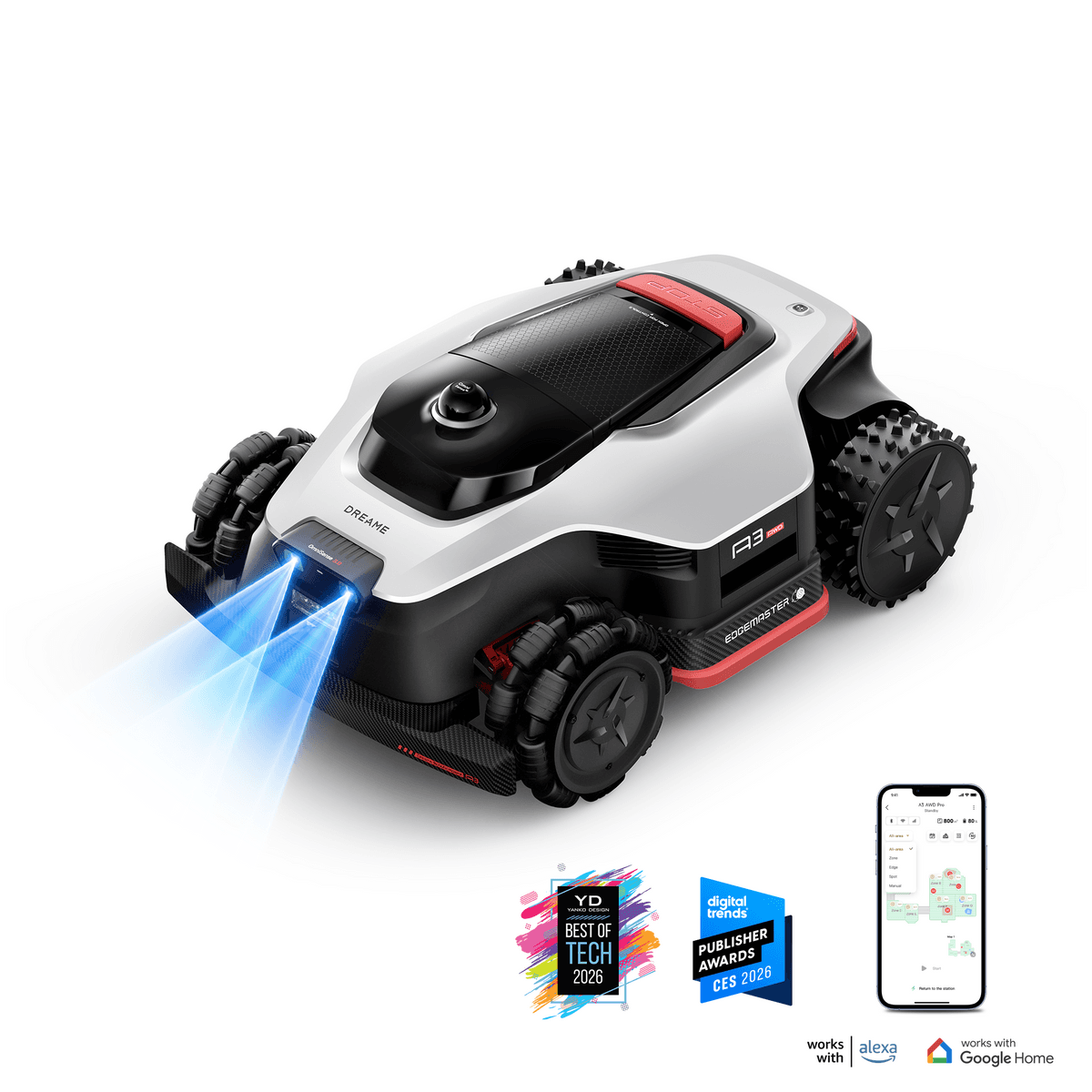
Image: Dreame official product photography. MowScout does not shoot original hardware photos; this is the manufacturer's image, used to illustrate the product.
Quick answer: how reliable is the Dreame A3, really?
The Dreame A3 AWD Pro is, on paper and in early reviews, one of the most capable wire-free mowers on the market. It navigates with a fusion of 3D LiDAR and AI vision (Dreame's OmniSense system) — no boundary wire, no RTK antenna, no clear-sky requirement — drives all four wheels to a claimed 80% (about 38.6°) slope, swings a wide 15.8-inch dual-disc deck, and pushes its EdgeMaster 2.0 disc out toward the border for one of the tightest edge cuts in the class. Reviewers describe a "highly structured driving style," reliable recognition of "over 300 different types of obstacles," and genuinely hands-off mowing once it's set up. That last clause is where the honest reliability story lives.
Here's the balanced picture from owners and reviewers:
- Capability and terrain: This is the A3's strong suit. Reviewers running it on hills praise the AWD stability, and our data rates it to an 80% slope — territory most rivals can't touch. See best robot mower for hills for where it sits among slope specialists.
- First-run software: The biggest early frustration. A mandatory firmware update can hang during setup — one reviewer lost "two to three hours" to it — and the app is described as capable but "not always intuitive."
- Mapping: Auto-mapping is rough; reviewers recommend driving a manual map instead. With no RTK fallback, positioning leans on stable visual landmarks, so big yard changes mean re-mapping.
- Obstacles and corners: Sensitivity is a balance to tune, and inward-facing corners are the one repeatable physical snag.
- Edges: EdgeMaster is excellent for a wire-free mower but still leaves a small strip, and its fixed height can scalp a tall-cut lawn.
- Brand track record: The real unknown. Dreame is new to US robot mowers, so multi-year reliability and support maturity are unproven versus the decades behind a Husqvarna.
Net verdict: the most capable spec sheet in its class, hobbled only by newer-brand growing pains. MowScout's spec-verified MowScout Score is a strong 90/100 for the Dreame A3 AWD Pro 3500. The problems below are the friction you should walk in expecting — mostly day-one setup and software maturity, plus the honest reliability-unknown of a 2025–2026 brand. Buy for the capability; watch the support maturity.
The most-reported Dreame A3 problems (and the fix for each)
Here is each recurring complaint with what owners and reviewers actually report and the fix or mitigation, cited. The biggest themes — firmware/app maturity, LiDAR-vision mapping, obstacle stops, and edges — get their own deep-dive sections after this.
1. Firmware update stalls during setup. What's reported: the mandatory first update can fail to load, stretching setup to "two to three hours"; one reviewer calls it "a common problem" echoed on the Dreame forum and Reddit. The fix: Dreame support says update on a stable internet connection with the docked battery above 15%; owner workarounds include switching the language to English, accepting the data-protection prompts quickly, and closing the control-unit flap. Detail below and in why your robot mower won't connect.
2. App isn't fully polished. What's reported: reviewers find "the user interface is not always intuitive, and minor problems can occasionally occur when editing maps" — "nothing dramatic," but real. The fix: keep firmware current; expect Dreame's OTA updates to smooth rough edges over time.
3. Auto-mapping is rough. What's reported: auto-mapping "produces very rough results, particularly along the top edges," and one reviewer's unit "didn't always recognize the edges of the lawn reliably and even got stuck." The fix: drive a manual map instead — reviewers say it "leads to much better results" and gives better control over where EdgeMaster trims.
4. No in-app boundary editing. What's reported: on the reviewed firmware "you cannot adjust the map boundaries in the app — if you want to move a boundary, you must manually guide the robot around again." The fix: map carefully the first time; watch for this to improve via updates.
5. Obstacle sensitivity is a balancing act. What's reported: set too low it "glides smoothly over anything in the grass"; set too high it "stops at every single pine cone." The fix: tune sensitivity to your yard and keep small debris cleared (deep-dive below).
6. Tight inward corners. What's reported: "in tight corners — typically where a wall meets a wall — it can struggle to reverse out again," as depth sensing is weakest there. The fix: soften the corner in the map or set a small no-go zone.
7. EdgeMaster's fixed height. What's reported: EdgeMaster 2.0 runs at a fixed 1.2-inch cut, so "if the main lawn is being cut at a taller height, the edge passes will scalp the perimeter." The fix: none in software yet — reviewers argue Dreame "should absolutely make this height adjustable"; for now, weigh it if you cut tall (deep-dive below).
8. Quality-of-life gaps. What's reported: no manual mow mode (drive-and-cut a specific patch), and a PIN required "every time it is lifted or tips over," which one reviewer calls "impractical" and a barrier to a neighbor helping a stuck unit. The fix: these are design choices to factor in, not faults to repair.
App and firmware maturity: the headline for a newer brand
For a brand this new to US mowing, software maturity is the single most important theme — and it's where the early reports concentrate. This isn't about a broken machine; it's about a first-generation product still finding its polish.
What owners and reviewers report: the flashpoint is the initial firmware update. One detailed review documented spending "two to three hours before I was finally able to set up the mower. In the end, it just wouldn't load the mandatory firmware update," and — crucially — notes "this is apparently (still) a common problem, as my research on the relevant Reddit forums and the Dreame forum itself revealed." Beyond setup, the app is described as capable but "not always intuitive," with "minor problems" that "can occasionally occur when editing maps." A related Dreame model even had an iOS episode where it "cannot be displayed in the app" with a "failed to load plugin" error after an update — the kind of teething issue that comes with a fast-moving software platform.
The fixes and mitigations: Dreame's own support is specific about update conditions — the robot should sit docked with a battery above 15% and, above all, have a stable internet connection, because most failed upgrades trace to a dropped connection mid-update. Owner-discovered workarounds for the setup hang include switching the robot's interface language to English, promptly accepting the data-protection consent prompts (which can flash by), and confirming the control-unit flap is closed. If an update fails, retry on strong Wi-Fi or 4G rather than force-closing the app mid-flash. The encouraging structural point: this is an actively updated, OTA platform — the same mechanism causing day-one friction is what smooths the app over the following months. If your unit won't come online at all, our robot mower won't connect guide walks the connection tree, and robot mower error codes decodes the specific alerts.
LiDAR and vision mapping: quirks to expect
The A3's headline feature is that it skips both the boundary wire and the RTK antenna, navigating instead with LiDAR plus AI vision. That's a real advantage under trees — LiDAR references physical objects, not satellites, so shade and canopy that stall an RTK mower don't inherently break it, and there's no antenna to plant in open sky. But the architecture has its own soft spots, and reviewers are clear about them.
What owners and reviewers report: the honest caveat is that visual-only navigation is "reliability-dependent on visual landmark stability." With no RTK fallback, a property with deciduous trees (a canopy that's dense in summer and bare in winter), frequent landscaping changes, or large featureless lawn sections can need "more iterative re-mapping than RTK-equipped competitors." Auto-mapping compounds this on day one: it "produces very rough results," and one reviewer's unit "didn't always recognize the edges of the lawn reliably and even got stuck" trying. This is the LiDAR mirror-image of the RTK problem — where a satellite mower needs open sky, a LiDAR mower wants nearby structure to reference, so a giant open expanse is the harder case, not the shaded one.
The fixes and mitigations: map manually rather than trusting auto-mapping — driving the perimeter yourself "leads to much better results" and, as a bonus, gives you control over where EdgeMaster trims. After any significant change to the yard (a removed tree, a new bed, seasonal leaf drop that alters the visual scene), re-verify or rebuild the map so the mower's landmarks match reality. Keep the LiDAR and camera lenses clean. And if your lawn is a wide, near-featureless field, watch the first few sessions to confirm the map holds before assuming it's set-and-forget. For heavily wooded yards where LiDAR is genuinely the right tool, see best robot mower for under trees for how the A3 compares to other canopy-friendly options.
Obstacle avoidance: false stops and the corner snag
Dreame leans hard on obstacle intelligence — the A3 identifies "over 300 different types of obstacles," from roots and branches to leaves and even wildlife — and reviewers largely praise how conservatively and cleanly it routes around clutter. The two honest gripes are about tuning and one specific geometry.
What owners and reviewers report: the sensitivity is a genuine balance. Dialed too low, the mower "glides smoothly over anything in the grass"; dialed too high, "it stops at every single pine cone and refuses to mow around the apple tree." That's the classic false-stop complaint — an over-cautious robot that halts for a tuft or a cone. The redeeming behavior owners note is persistence: the A3 "returns to previously avoided areas once the obstacle is gone and cleans them up," so a temporary blockage doesn't leave a permanent bald patch. The one repeatable physical snag is inward-facing corners — "typically where a wall meets a wall — it can struggle to reverse out again," because the sensors "could be better at assessing depth in these situations." Separately, reviewers running it on soft or damp ground noted the machine's heft can leave "slight marks when turning."
The fixes and mitigations: tune obstacle sensitivity to your yard — dial it up if you have pets or debris you want given a wide berth, down if it's stopping for harmless tufts. Keep the lawn clear of small movable objects before a run. For the corner trap, soften the geometry in the map or drop a small no-go zone so the mower doesn't wedge itself, and hand-trim that pocket. And on soft or wet turf, mow when it's drier and vary the mowing angle so turns don't repeat in one spot. If a specific fault code accompanies a stop, cross-reference robot mower error codes.
Edges: how good is EdgeMaster 2.0, really?
Edge cutting is where the A3 tries hardest to beat the category — and mostly succeeds. Most robot mowers leave a border strip because the blade disc sits inboard of the wheels; Dreame's EdgeMaster 2.0 extends the cutting disc outward toward the boundary to shrink that strip. It works: reviewers measured "edge accuracy of less than 3 cm," and Dreame's spec of an under-1.2-inch disc-to-edge gap is the tightest in the wire-free Tier-1 slate. Our data rates its edge cutting "good" for the class, and that's fair — it gets closer than a Navimow or a stock LUBA. But "close" isn't "zero," and there are two honest asterisks.
What owners and reviewers report: first, a strip still remains — "the safety margin set during setup is still visible as an uncut strip," meaning "the edge trimmer can't be retired just yet." Second, and more specific, EdgeMaster runs at a fixed 1.2-inch cutting height. As one reviewer put it: "if the main lawn is being cut at a taller height, the edge passes will scalp the perimeter" — "a genuine compatibility problem for anyone running the mower at taller settings during drought conditions." The same review argues plainly that "Dreame should absolutely make this height adjustable." Reviewers also note that fine-tuning edges around bushes and complex borders is under-documented, so early adopters "spend more time tuning versus plug-and-play."
The fixes and mitigations: map edges manually so you control exactly where EdgeMaster engages, and keep it off beds where a scalped 1.2-inch strip would look worse than an uncut one. If you deliberately cut the main lawn tall (common for warm-season grasses in Sun-Belt heat), weigh the fixed-height trade-off before buying, and consider disabling edge mode on those zones. Keep a string trimmer for the final few percent along walls and curves — that's true of every robot mower, the A3 just leaves you less of it to do.
The newer-brand question: support and track record, honestly
This is the part a spec sheet can't answer, and it's the fairest reason to pause. Dreame is a real, established robotics company — it's well known for premium robot vacuums — but in US robot mowers it is a 2025–2026 newcomer, and that matters for a $3,000 purchase you expect to run for years.
What reviewers and owners report: the recurring caution is the absence of history — "no multi-year ownership data — Dreame is new to the US robot mower market vs. Husqvarna's 30-year Automower history." Reviewers also flag paperwork gaps: "warranty terms not yet confirmed for the US market" on the product page at the time of review, with an explicit "verify before purchase" note, and even missing basics like a published charge time. Zooming out to Dreame's broader US customer feedback (largely from its vacuum line), some buyers on review sites describe firmware pushes that bricked expensive machines with "no rollback option," and support that leaned on "copy-paste" replies — a pattern worth knowing, even though it isn't mower-specific and the mower line is too new to have its own multi-year verdict.
The balanced reality: none of this means the A3 is unreliable — it means it's unproven, which is a different and more honest thing. Dreame does provide US support channels (live chat, phone, and email) and a limited warranty on units bought through authorized channels; our data records a 2-year warranty, and there's a standard 30-day return window on official purchases. The mitigations that count: buy through an authorized channel (Amazon or an official retailer) so warranty and returns apply cleanly, verify the current US warranty terms on Dreame's page before you pay, keep proof of purchase, and lean on the fact that the OTA-update model — the same thing causing day-one firmware friction — is also how a young platform matures. If a proven decades-long support network matters more to you than a bleeding-edge spec sheet, that's a legitimate reason to choose an established brand instead, and our robot lawn mower buyer's guide weighs that trade-off across the market.
Who should buy the Dreame A3 — and who should wait for a longer track record
Buy the Dreame A3 AWD Pro if:
- You have a steep, complex, or sloped yard — true AWD to an 80% slope is genuinely rare, and reviewers rate its hill stability highly. Start at best robot mower for hills.
- You want wire-free and antenna-free navigation and don't want to plant an RTK station — the LiDAR-plus-vision approach also tolerates tree cover better than a satellite mower.
- You value a wide deck for fast mowing and one of the tightest edge cuts available in a wire-free machine.
- You're comfortable being an early adopter: you'll map manually, tune obstacle sensitivity, ride out a first-run firmware update, and accept an evolving app.
Wait for a longer track record if:
- You want proven, multi-year reliability and a mature support network above all — Husqvarna and other long-established brands have decades the A3 simply hasn't earned yet.
- Your lawn is a wide-open, featureless field — LiDAR wants landmarks to reference, so this is the architecture's weakest case; confirm the map holds first.
- You cut the main lawn tall and care about perimeter appearance — EdgeMaster's fixed 1.2-inch height can scalp the edge.
- You want plug-and-play simplicity with minimal tuning and a rock-solid app on day one.
Honest bottom line: the Dreame A3 AWD Pro is not a flawed machine — it's a first-generation flagship with the most capable spec sheet in its class and the growing pains to match. The mechanical hardware (AWD, slope, deck, edges) is excellent; the friction is software maturity and the unavoidable reliability-unknown of a brand new to US mowing. Buy it for the capability, go in expecting to tune it, and factor the shorter support history into your decision. For the deeper spec breakdown, read our full Dreame A3 AWD Pro review.
Frequently asked questions
Is the Dreame A3 AWD Pro reliable? On its capability, reviewers are impressed — a true four-wheel-drive, no-RTK LiDAR-plus-vision flagship rated to an 80% slope, with a wide 15.8-inch deck and one of the tightest wire-free edge cuts. MowScout's spec-verified read is a strong 90/100. The honest asterisk is track record: Dreame is new to the US robot-mower market, so the recurring complaints are maturity, not mechanical — a first-run firmware update that can stall setup, an app reviewers call "not always intuitive," auto-mapping that needs a manual redo, and the occasional obstacle false-stop or corner snag. None are catastrophic, and Dreame pushes over-the-air fixes. Buy it for the capability; walk in expecting to tune it and to have a shorter support history behind you than a Husqvarna.
Why won't my Dreame A3 finish its firmware update or complete setup? A stalled first-run firmware update is the single most-reported early Dreame A3 frustration — one reviewer spent "two to three hours" before the mandatory update would load, and calls it "a common problem" echoed on the Dreame forum and Reddit. Dreame's own support says the robot needs a battery above 15% while docked and, above all, a stable internet connection for the upgrade to succeed. Owner-found workarounds include setting the robot's language to English, accepting the data-protection prompts promptly, and making sure the control-unit flap is closed. If it still hangs, retry on a strong Wi-Fi or 4G signal rather than force-quitting mid-update.
Does the Dreame A3 work under trees and on open, featureless lawns? It handles shade better than an RTK mower because it navigates with LiDAR and AI vision, not satellites — there's no clear-sky requirement and no antenna to plant. Reviewers do flag the flip side: with no RTK fallback, positioning "is reliability-dependent on visual landmark stability," so deciduous trees dropping leaves, frequent landscaping changes, or "large featureless lawn sections" can need "more iterative re-mapping than RTK-equipped competitors." Keep the map current after big yard changes, and for a genuinely wide-open field or heavy continuous canopy, confirm the map holds over a few sessions.
Why does my Dreame A3 stop for obstacles or get stuck in corners? The A3 recognizes 300-plus obstacle types, and reviewers note the sensitivity is a balance: set too low it "glides smoothly over anything in the grass," set too high it "stops at every single pine cone." The upside owners report is that it returns to previously blocked spots once the obstacle is gone and cleans them up. The one repeatable physical snag is inward-facing corners — where a wall meets a wall it "can struggle to reverse out again," as depth sensing is weakest there. Fixes: tune obstacle sensitivity to your yard, keep the lawn clear of small debris, and draw a no-go zone or soften a tight corner in the map.
How good are the Dreame A3's edges, and does EdgeMaster leave a strip? Better than most wire-free rivals, not perfect. The EdgeMaster 2.0 extending disc gets the cut to under 1.2 inches from a hard border — reviewers measured "edge accuracy of less than 3 cm" — the tightest in its class. But two caveats: the safety margin set during setup still leaves a visible uncut strip, so "the edge trimmer can't be retired just yet," and EdgeMaster runs at a fixed 1.2-inch height, so if you cut the main lawn tall it can scalp the perimeter. Map edges manually for best control and keep a string trimmer for the last few percent.
Is Dreame a trustworthy brand for a $3,000 mower? Dreame is an established robotics maker (well known for vacuums), but it's a newer entrant in US robot mowers, so the long-term reliability picture is genuinely unproven versus Husqvarna's decades of Automower history — reviewers flag "no multi-year ownership data" and note US warranty terms should be verified on the product page before you buy. Dreame does offer US support (live chat, phone, email) and a limited warranty on authorized-channel purchases, plus OTA firmware. Our take: the hardware and spec sheet are the most capable in the class, but you're an early adopter on support maturity — buy accordingly.
The bottom line
The Dreame A3 AWD Pro's "problems" are, almost without exception, the growing pains of a first-generation flagship from a brand new to US mowing — not signs of a bad machine. Its hardware is the most capable in its class: true all-wheel drive to an 80% slope, wire-free and antenna-free LiDAR-plus-vision navigation that tolerates tree cover, a wide fast-cutting deck, and one of the tightest edge cuts you can buy without a wire. The friction is real but bounded — survive the first firmware update, map manually, tune obstacle sensitivity, keep a trimmer for the edges, and accept an app that's still maturing. The one thing no fix erases is time: this brand hasn't yet earned the multi-year track record that a Husqvarna has. Buy the A3 for its capability with eyes open on support maturity, and it's one of the most impressive wire-free mowers of 2026. It earns its 90/100 MowScout Score.
Not sure whether the A3's capability outweighs its newer-brand risk for your yard? The configurator asks about slope, shade, size, and how much you value a proven track record, then returns the three models that actually fit:
Find your robot mower → answer a few questions, get your top 3
Keep reading: the category overview at robot lawn mowers, the full Dreame A3 AWD Pro review, how it stacks up for slopes in best robot mower for hills, and the cross-brand shortlist in the robot lawn mower buyer's guide.
---
Sources
- FreshlyCharged — Dreame A3 AWD Pro review (tight-corner reversing, PIN-on-lift, no in-app boundary edit, obstacle-sensitivity balance, returns to cleared spots, EdgeMaster)
- LBTechReviews — Dreame A3 AWD Pro 2500 review (EdgeMaster fixed 1.2-inch height scalps tall lawns, no manual mow mode, auto-mapping rough vs. manual mapping)
- LawnCareGuides — Dreame A3 AWD Pro review (visual-landmark dependency, no RTK fallback, featureless-lawn re-mapping, documentation gaps, unconfirmed US warranty, brand-maturity vs. Husqvarna)
- Basic-Tutorials — Dreame A3 AWD Pro 3500 review (firmware-update stall at setup, app not always intuitive, map-edit quirks, turf marks on soft ground, 300 obstacle types, <3 cm edge accuracy, 80% slope stability)
- Android Authority — Dreame A3 AWD Pro hands-on impressions (OmniSense LiDAR + AI vision, setup and mapping refinement)
- Dreame Support — A3 AWD Pro Firmware Update Issues
- Dreame Support — Fixing Firmware Upgrade Issues (battery above 15% while docked; stable internet required)
- Dreame Forum — robot-mower software-update discussion thread
- Dreame US — Return and Warranty Policy (authorized-channel limited warranty, 30-day return)
- Trustpilot — Dreame Technology customer reviews (firmware/brick and support-responsiveness concerns across Dreame's US product line)
- T3 — Dreame's AI-powered 4WD robot mower tackles serious slopes (AWD/80% slope context)
Disclosure: MowScout is spec-verified and data-driven, not a hands-on test lab. Problems on this page are attributed to the owners, reviewers, and manufacturer support documents cited above, not to our own testing. We may earn a commission on purchases made through some links, at no cost to you; this never affects our verdicts. Prices and specs were current at the last update and can change — verify before buying.
Recommended next step
Use this guide to understand the buying issue, then run the configurator with your exact acreage, slope, tree cover, zones, terrain, obstacles, and budget. The best recommendation should survive both the guide logic and the yard-fit filters. If a brand claim or retailer listing conflicts with the guidance here, trust the measured yard constraints first and recheck the exact model page before buying. Document the final assumptions.
Buyer questions
FAQ
Is the Dreame A3 AWD Pro reliable?
On its capability, reviewers are impressed — a true four-wheel-drive, no-RTK LiDAR-plus-vision flagship rated to an 80% slope, with a wide 15.8-inch deck and one of the tightest wire-free edge cuts. MowScout's spec-verified read is a strong 90/100. The honest asterisk is track record: Dreame is new to the US robot-mower market, so the recurring complaints are maturity, not mechanical — a first-run firmware update that can stall setup, an app that reviewers call 'not always intuitive,' auto-mapping that needs a manual redo, and the occasional obstacle false-stop or corner snag. None are catastrophic, and Dreame pushes over-the-air fixes. Buy it for the capability; walk in expecting to tune it and to have a shorter support history behind you than a Husqvarna.
Why won't my Dreame A3 finish its firmware update or complete setup?
A stalled first-run firmware update is the single most-reported early Dreame A3 frustration — one reviewer spent 'two to three hours' before the mandatory update would load, and calls it 'a common problem' echoed on the Dreame forum and Reddit. Dreame's own support says the robot needs a battery above 15% while docked and, above all, a stable internet connection for the upgrade to succeed. Owner-found workarounds include setting the robot's language to English, accepting the data-protection prompts promptly, and making sure the control-unit flap is closed. If it still hangs, retry on a strong Wi-Fi or 4G signal rather than force-quitting mid-update.
Does the Dreame A3 work under trees and on open, featureless lawns?
It handles shade better than an RTK mower because it navigates with LiDAR and AI vision, not satellites — there's no clear-sky requirement and no antenna to plant. Reviewers do flag the flip side: with no RTK fallback, positioning 'is reliability-dependent on visual landmark stability,' so deciduous trees dropping leaves, frequent landscaping changes, or 'large featureless lawn sections' can need 'more iterative re-mapping than RTK-equipped competitors.' Keep the map current after big yard changes, and for a genuinely wide-open field or heavy continuous canopy, confirm the map holds over a few sessions.
Why does my Dreame A3 stop for obstacles or get stuck in corners?
The A3 recognizes 300-plus obstacle types, and reviewers note the sensitivity is a balance: set too low it 'glides smoothly over anything in the grass,' set too high it 'stops at every single pine cone.' The upside owners report is that it returns to previously blocked spots once the obstacle is gone and cleans them up. The one repeatable physical snag is inward-facing corners — where a wall meets a wall it 'can struggle to reverse out again,' as depth sensing is weakest there. Fixes: tune obstacle sensitivity to your yard, keep the lawn clear of small debris, and draw a no-go zone or soften a tight corner in the map.
How good are the Dreame A3's edges, and does EdgeMaster leave a strip?
Better than most wire-free rivals, not perfect. The EdgeMaster 2.0 extending disc gets the cut to under 1.2 inches from a hard border — reviewers measured 'edge accuracy of less than 3 cm' — the tightest in its class. But two caveats: the safety margin set during setup still leaves a visible uncut strip, so 'the edge trimmer can't be retired just yet,' and EdgeMaster runs at a fixed 1.2-inch height, so if you cut the main lawn tall it can scalp the perimeter. Map edges manually for best control and keep a string trimmer for the last few percent.
Is Dreame a trustworthy brand for a $3,000 mower?
Dreame is an established robotics maker (well known for vacuums), but it's a newer entrant in US robot mowers, so the long-term reliability picture is genuinely unproven versus Husqvarna's decades of Automower history — reviewers flag 'no multi-year ownership data' and note US warranty terms should be verified on the product page before you buy. Dreame does offer US support (live chat, phone, email) and a limited warranty on authorized-channel purchases, plus OTA firmware. Our take: the hardware and spec sheet are the most capable in the class, but you're an early adopter on support maturity — buy accordingly.